
Louis, in Manchester, is not built around a period reference. It is built around a character. Developed by Fabled Studio for Permanently Unique Group, the restaurant and live performance venue takes its cues from a fictional Sicilian immigrant's rise through 1950s Little Italy, and the shadow that followed. We spoke with co-founders Steven Saunders and Tom Strother about narrative-led design, the mechanics of atmosphere, and how a room holds its own across a long evening.

Louis, Manchester. The room reveals itself on arrival. All photos by James McDonald.
How did the story of Louis begin?
The client referenced Louis’ Café from The Godfather as a starting point, so we began with that slice of old-school downtown New York. From there, we rewatched Goodfellas, particularly the Copacabana scene, which captured the balance we were interested in: the period glamour and kitsch of the club, set against something darker and more brooding.
We then developed Louis as a character. He became a “boy done good” from Palermo, Sicily, who travelled to America to realise his dream and opened a successful restaurant in Little Italy. As his success grew, he came onto the radar of the New York mob and was slowly drawn into the criminal underworld. That personal rise and fall became a way to give the space its own story, rather than simply styling it around a period reference.
Fabled Studio is known for narrative-led interiors. What separates an immersive space from one that looks impressive?
For us, it comes down to the integrity of the concept. We spend a huge amount of time developing the narrative so that every material, detail and touchpoint speaks to it. Not in an overly themed or forced way, but through subtle layers.
Nothing should feel like decoration for decoration’s sake. Everything has a reason for being there, and when a guest asks why, it gives the operator a chance to talk about the design in a way that adds to the experience. A shared vision with the client is also key. The operator has to understand the level of service and atmosphere that the interior is designed to support.
 The main dining room at Louis, Manchester.
Louis draws on old-world glamour without feeling like a period recreation. How did you avoid making those references too literal?
We often reference period moments, but we never want to create a time warp. It is too easy to copy historic details directly. Instead, we use those details as starting points and combine them with more contemporary colour, pattern and material choices.
We wanted guests to feel transported to another time and place. Louis is unusual compared with many contemporary venues because it has a chic, elegant dress code and a no-camera-phone policy. Guests have to consciously make an effort to attend, and without their phones, they are encouraged to live in the moment rather than endlessly documenting the experience. That makes a huge difference to the level of immersion, and helps people engage with the room, the performance, the food and each other.
Louis shifts from early evening dining to late-night energy. How did the design support that transition?
That shift comes down to lighting and operations working together. As the evening progresses, the lighting becomes darker, the DJ takes over from the live band, and the staff increase the energy of the room. Champagne carts come out, and the whole venue becomes more theatrical. Those operational changes have to be considered in the design from the beginning. The space needs to support dinner, performance and a more party-led atmosphere without feeling like three separate venues.

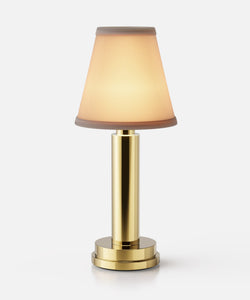
At Louis, the tables glow quietly within the room. The Victoria cordless lamp in cream pleated silk.
How closely did you work with the operator when shaping the layout?
We work with operators from the very outset, because every operator has their own way of doing things. With Louis, the interior was designed around the show, so sightlines to the stage from every seat in the house were essential. We also wanted the space to reveal itself gradually. Guests arrive through a dark, brooding timber vestibule before entering the main auditorium, where the spectacle of the room is finally revealed. That sense of anticipation and reveal is something we like to build into our customer journeys, and Permanently Unique Group really appreciated that approach.
Louis is theatrical and open, but still intimate at the table. How did lighting help create that balance?
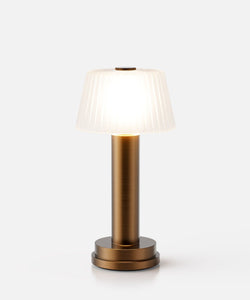
Lighting is key to intimacy. At Louis, the stage lighting focuses attention on the band, while the light fades towards the edges of the room. The tables are deliberately soft and restrained, with silk-shaded wall lights and NEOZ Victoria lamps creating warm pools of light. We wanted the tables to glow within the relative darkness of the surrounding room, recalling old New York jazz clubs and cabaret bars of the 1950s. Less is more in a space like this. The focus should not be on illuminating every architectural detail, but on creating layers of light that can be adjusted as the mood of the room changes.
When in Manchester
Louis is located at 3 Hardman Square, Manchester. Open Tuesday to Sunday, with weekend afternoon sittings and late-night service until 2 am on Fridays and Saturdays.